407 7th St NW Albuquerque, NM 87102
info@collinsattorneys.com

When law enforcement or government agencies abuse their power, the physical and emotional toll is devastating. Whether you have suffered from excessive force by the Albuquerque Police Department (APD), medical neglect at the Metropolitan Detention Center (MDC), or systemic abuse within CYFD, you face a complex legal system designed to protect the institution, not you.
At Collins & Collins, P.C., we level the playing field. We are Albuquerque civil rights lawyers dedicated to holding government actors and private contractors accountable. We utilize both federal Section 1983 claims and the powerful New Mexico Civil Rights Act to seek justice for victims of constitutional violations.
If you believe your rights were violated, do not wait because strict deadlines can apply. Certain claims against New Mexico government entities require a written Tort Claims Act notice within 90 days (though wrongful death cases allow 6 months). Failure to act within this window can permanently bar your claim.
Call (505) 242-5958 for an immediate review.
Historically, government officials have hidden behind a legal defense known as Qualified Immunity, which shields them from liability unless they violated “clearly established” law. This doctrine has frequently blocked victims of police brutality and jail neglect from receiving justice.
However, the New Mexico Civil Rights Act (NMCRA) has fundamentally changed the landscape for accountability:
Civil rights cases involve violations of rights guaranteed by the U.S. Constitution or the New Mexico Constitution. In practice, that can mean unconstitutional force, illegal detention, censorship/retaliation for protected speech, or deliberate indifference to medical needs in custody. Civil rights violations can also involve discriminatory treatment by a government actor or state-funded institution, often tied to protected characteristics such as race, ethnicity, disability, gender, or religion.
Our practice is laser-focused on high-stakes constitutional litigation, custodial negligence, and institutional abuse.
We hold law enforcement agencies, including APD, BCSO, and State Police, accountable for violating the fundamental right to be free from unreasonable search and seizure. As Albuquerque civil rights attorneys, our litigation focuses on:
We also represent individuals who have faced First Amendment retaliation, specifically those targeted or arrested for exercising their right to free speech, protest, or filming police activities.
Our firm specializes in custodial negligence within New Mexico’s correctional facilities, including the MDC and state prisons. Our prison abuse attorneys litigate cases involving physical abuse by guards, the failure to protect inmates from known threats of peer violence, and the use of unconstitutional methods such as solitary confinement for individuals with behavioral health needs. We target the “customs and policies” that allow violence and inhumane conditions to persist behind bars.
When the state removes a child from their home, it assumes a heightened duty of care. We litigate systemic failures within the Children, Youth & Families Department (CYFD), specifically addressing foster care sexual abuse and the “shuffling” of children into unsafe group homes. Our child abuse lawyers also advocate for children’s rights in cases involving ICWA placement violations and systemic neglect by state-regulated agencies.
Unlike standard medical malpractice, our litigation targets the deprivation of rights and dignity in nursing homes and assisted living facilities. Our elderly rights lawyers investigate cases where deliberate corporate understaffing leads to catastrophic nursing home neglect, such as Stage 3 or 4 bedsores, malnutrition, and elopement. We hold these facilities accountable for violating resident safety and prioritizing profit over the care of New Mexico’s seniors.
The “deliberate indifference” to serious medical and mental health needs is a core violation of civil rights. Our mental health lawyers represent detainees and patients who are denied life-saving treatment, focusing on jail medical abuse such as untreated fentanyl withdrawal, sepsis, and suicide. This practice area also addresses the unconstitutional use of chemical restraints and the failure to provide mandatory psychiatric intervention.
Corporations that profit from incarceration or court-ordered treatment are “State Actors” and must be held to constitutional standards. We aggressively litigate against for-profit Residential Treatment Centers (RTCs) and private equity-run facilities that prioritize “bed days” over patient safety. Our firm targets business models that incentivize cutting costs on staff training and emergency medical transfers, which leads to systemic abuse and wrongful death in custody.
Unlike firms that handle general employment disputes or minor discrimination claims, Collins & Collins, P.C. specializes in cases of Custodial Deprivation. We litigate where the power imbalance is greatest: jails, foster homes, and state-regulated facilities.
Pattern and Practice Litigation
We don’t just sue for one bad act; we look for “pattern and practice” evidence. In federal cases, we use Monell theories to show that an agency like APD or CYFD has a systemic habit of violating rights through policies, training failures, or tolerated misconduct.
Bypassing Qualified Immunity
While other firms may struggle with the federal Qualified Immunity hurdle, our mastery of the New Mexico Civil Rights Act allows us to hold government bodies directly accountable in state court.
Protecting Vulnerable Populations
We represent people the system often ignores; those harmed in detention, in foster placements, and in state-regulated facilities where oversight fails and abuse is allowed to repeat.
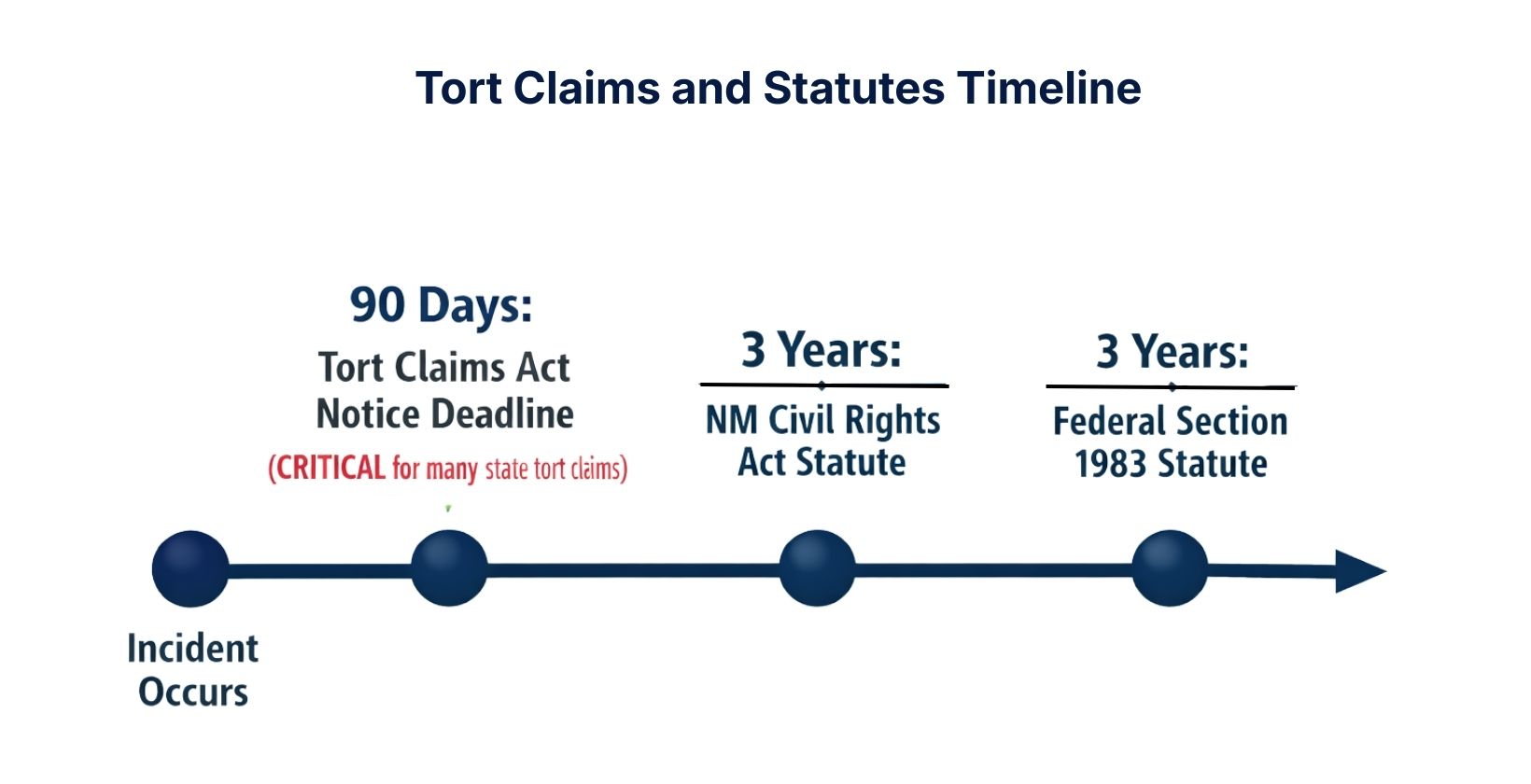
One of the biggest threats to a valid civil rights case is a missed deadline. While the statute of limitations for filing a lawsuit may be up to three years, New Mexico’s Tort Claims Act can impose a much stricter notice requirement.
Do not assume you have time. If you were mistreated by police or jail staff, contact Collins & Collins, P.C. immediately so we can help protect your procedural rights.
To maximize your compensation, our civil rights lawyers analyze whether to file your case in federal court (U.S. District Court for the District of New Mexico) or state court.
The federal statute, 42 U.S.C. § 1983, allows individuals to sue for civil rights violations. These cases allow for punitive damages against individual officers, which are intended to punish the wrongdoer. However, these claims often face the hurdle of Qualified Immunity.
Claims under the NMCRA are filed against the public body (the city, county, or agency). The NMCRA provides for actual damages and caps recovery per claimant (with annual inflation adjustments), and it does not provide the same punitive-damages framework used in many federal § 1983 cases. The prohibition of Qualified Immunity often makes the NMCRA a more viable path for securing justice.
Our attorneys build a strategic roadmap for every client, often pleading alternative theories to ensure the strongest possible case against entities like the City of Albuquerque or Bernalillo County.
Government agencies control the evidence needed to prove your case. They often delay or obscure records to protect themselves. Our legal team moves aggressively to preserve and obtain critical evidence using the New Mexico Inspection of Public Records Act (IPRA) and subpoena power.
Our civil rights attorneys in Albuquerque focus on securing:
In civil rights litigation, compensation is about more than just medical bills; it is about the valuation of your liberty and human dignity. When an institution or officer violates the Constitution, the law provides specific remedies to “make the victim whole” and, in some cases, to punish the wrongdoer.
Our civil rights lawyers strategically analyze every case to determine whether to pursue damages in state or federal court, as the available remedies differ significantly:
Civil rights litigation against government agencies and public institutions requires early evaluation and sophisticated evidence handling. Collins & Collins, P.C. begins each case by identifying the specific government actors involved, the authority they exercised, and the constitutional rights at issue.
Our strategy for achieving accountability includes:
If you’re weighing whether what happened “counts” as a civil rights violation, get a confidential case evaluation now. Call (505) 242-5958 or request a review online; no pressure, no upfront attorney fees, and no obligation to move forward unless you choose to.
An inmate died during opioid withdrawal in a county jail due to neglect by medical and jail staff, prompting wrongful death and civil rights claims.
A woman died preventably in county jail detox under a private medical contractor amid ignored emergencies and neglect. Civil rights claims allege systemic failures; damages limited by contractor bankruptcy.
A man died in police custody after repeated taser use and denied medical care, leading to a $5 million wrongful death settlement.
An inmate with serious mental illness died by suicide due to neglected care, leading to a $1.6 million civil rights settlement.
A combat veteran with severe mental illness died by suicide in solitary confinement after neglect, resulting in a $1.5 million settlement.
A detainee with schizophrenia died after delayed care and solitary confinement at a private facility, settling for $1.5 million with the hospital.
An incarcerated man died after a private hospital withdrew life support without family consent, settling for $1.5 million.
A man died from untreated alcohol withdrawal in county jail, settling wrongful death claims for $1.15 million.
“Note: Past results do not guarantee any future outcome, and every case is different.”
We simplify complex legal matters by providing clear, concise, and accurate answers to your most pressing questions.
Generally, three years. For federal Section 1983 claims and claims under the New Mexico Civil Rights Act, you typically have three years from the date of the violation to file a lawsuit. However, strictly adhering to the 90-day Tort Claims Notice requirement is essential for preserving all potential state-based negligence claims.
We work on a contingency fee basis. This means you do not pay any attorney fees upfront. Our firm advances the costs of litigation (such as filing fees and expert witnesses), and we only get paid if we recover compensation for you through a settlement or verdict. Clients may be responsible for litigation costs depending on the outcome of the case.
Yes. If you were arrested without probable cause, or if evidence was fabricated against you, you may have a claim for false arrest or malicious prosecution, even if, and sometimes because, the criminal charges were eventually dismissed.
Yes. You can sue the City of Albuquerque for the actions of APD officers. Under the New Mexico Civil Rights Act, the public body is vicariously liable for the constitutional violations committed by its employees. We also litigate against the Bernalillo County Sheriff’s Office, New Mexico Corrections Department, and private contractors providing medical care in jails.
Accountability is the only way to prevent future abuses of power. At Collins & Collins, P.C., we have the resources and experience to litigate against powerful government entities in New Mexico. We handle cases involving serious injury, wrongful death, and systemic rights violations.
Don’t let the 90-day deadline expire on your claim.
Request your confidential case review online or call us at (505) 242-5958. Let us fight to protect your rights and dignity.
"*" indicates required fields
Available 24/7 Online
Copyright © 2026 – Collins & Collins P.C. All Rights Reserved.
Past results do not guarantee any future outcome, and every case is different.
Collins & Collins, P.C.
Accessibility Statement
Compliance status
We firmly believe that the internet should be available and accessible to anyone, and are committed to providing a website that is accessible to the widest possible audience, regardless of circumstance and ability.
To fulfill this, we aim to adhere as strictly as possible to the World Wide Web Consortium’s (W3C) Web Content Accessibility Guidelines 2.1 (WCAG 2.1) at the AA level. These guidelines explain how to make web content accessible to people with a wide array of disabilities. Complying with those guidelines helps us ensure that the website is accessible to all people: blind people, people with motor impairments, visual impairment, cognitive disabilities, and more.
This website utilizes various technologies that are meant to make it as accessible as possible at all times. We utilize an accessibility interface that allows persons with specific disabilities to adjust the website’s UI (user interface) and design it to their personal needs.
Additionally, the website utilizes an AI-based application that runs in the background and optimizes its accessibility level constantly. This application remediates the website’s HTML, adapts Its functionality and behavior for screen-readers used by the blind users, and for keyboard functions used by individuals with motor impairments.
If you’ve found a malfunction or have ideas for improvement, we’ll be happy to hear from you. You can reach out to the website’s operators by using the following email
Screen-reader and keyboard navigation
Our website implements the ARIA attributes (Accessible Rich Internet Applications) technique, alongside various different behavioral changes, to ensure blind users visiting with screen-readers are able to read, comprehend, and enjoy the website’s functions. As soon as a user with a screen-reader enters your site, they immediately receive a prompt to enter the Screen-Reader Profile so they can browse and operate your site effectively. Here’s how our website covers some of the most important screen-reader requirements, alongside console screenshots of code examples:
Screen-reader optimization: we run a background process that learns the website’s components from top to bottom, to ensure ongoing compliance even when updating the website. In this process, we provide screen-readers with meaningful data using the ARIA set of attributes. For example, we provide accurate form labels; descriptions for actionable icons (social media icons, search icons, cart icons, etc.); validation guidance for form inputs; element roles such as buttons, menus, modal dialogues (popups), and others. Additionally, the background process scans all the website’s images and provides an accurate and meaningful image-object-recognition-based description as an ALT (alternate text) tag for images that are not described. It will also extract texts that are embedded within the image, using an OCR (optical character recognition) technology. To turn on screen-reader adjustments at any time, users need only to press the Alt+1 keyboard combination. Screen-reader users also get automatic announcements to turn the Screen-reader mode on as soon as they enter the website.
These adjustments are compatible with all popular screen readers, including JAWS and NVDA.
Keyboard navigation optimization: The background process also adjusts the website’s HTML, and adds various behaviors using JavaScript code to make the website operable by the keyboard. This includes the ability to navigate the website using the Tab and Shift+Tab keys, operate dropdowns with the arrow keys, close them with Esc, trigger buttons and links using the Enter key, navigate between radio and checkbox elements using the arrow keys, and fill them in with the Spacebar or Enter key.Additionally, keyboard users will find quick-navigation and content-skip menus, available at any time by clicking Alt+1, or as the first elements of the site while navigating with the keyboard. The background process also handles triggered popups by moving the keyboard focus towards them as soon as they appear, and not allow the focus drift outside it.
Users can also use shortcuts such as “M” (menus), “H” (headings), “F” (forms), “B” (buttons), and “G” (graphics) to jump to specific elements.
Disability profiles supported in our website
Additional UI, design, and readability adjustments
Browser and assistive technology compatibility
We aim to support the widest array of browsers and assistive technologies as possible, so our users can choose the best fitting tools for them, with as few limitations as possible. Therefore, we have worked very hard to be able to support all major systems that comprise over 95% of the user market share including Google Chrome, Mozilla Firefox, Apple Safari, Opera and Microsoft Edge, JAWS and NVDA (screen readers).
Notes, comments, and feedback
Despite our very best efforts to allow anybody to adjust the website to their needs. There may still be pages or sections that are not fully accessible, are in the process of becoming accessible, or are lacking an adequate technological solution to make them accessible. Still, we are continually improving our accessibility, adding, updating and improving its options and features, and developing and adopting new technologies. All this is meant to reach the optimal level of accessibility, following technological advancements. For any assistance, please reach out to