
Medical negligence in Albuquerque? Collins & Collins, P.C. advocates for victims and ensures justice is served. Take Action for Justice.
407 7th St NW Albuquerque, NM 87102
info@collinsattorneys.com
Patients in Albuquerque place their lives and trust in the hands of doctors, surgeons, and nurses, expecting competent care. When a preventable medical error violates that trust, the physical, emotional, and financial consequences can be devastating.
At Collins & Collins P.C., we understand that medical negligence is not just about a bad outcome. It is about a violation of safety rules that protect us all. Whether your injury occurred at UNM Hospital, Presbyterian, Lovelace, or a private surgical center, our Albuquerque medical malpractice attorneys help patients and families navigate the complex legal system to pursue accountability and compensation. We are here to ensure your voice is heard.
Our firm operates on a contingency fee basis. You pay no attorney fees unless we obtain a recovery. Call us now!
Medical malpractice occurs when a healthcare professional or institution fails to provide the accepted standard of care, resulting in injury or death. It is important to understand that a bad outcome does not automatically mean malpractice occurred. Medicine has inherent risks.
However, when a doctor’s action, or inaction, falls below what a reasonably competent peer would do under similar circumstances, that is negligence.
To succeed in a claim under New Mexico law, our attorneys must prove four specific elements by a preponderance of the evidence:
In New Mexico, the standard of care is determined by what a reasonably well-qualified healthcare provider would do in the same locality. This means an emergency room doctor is judged against the standards of other ER doctors in the Albuquerque area.
Proving a violation of this standard requires a deep understanding of medical protocols and the support of independent medical experts. We work with board-certified specialists who review records to determine if the care you received fell below acceptable limits.
Medical errors can occur in any setting, from a routine clinic visit to complex surgery. Our medical malpractice lawyers in Albuquerque handle a wide range of cases involving:
Delayed diagnosis
Failure to timely identify a medical condition, allowing it to progress unnecessarily.
Misdiagnosis
Incorrect diagnosis leading to improper or delayed treatment.
Surgical errors
Preventable mistakes during surgery, including procedural or intraoperative errors.
Medication and prescription errors
Errors involving prescribing, dispensing, or administering medications.
Birth injuries and obstetric negligence
Preventable injuries during pregnancy, labor, or delivery resulting from substandard care.
Failure to provide appropriate follow-up care
Lack of monitoring, reassessment, or continuation of necessary treatment.
Anesthesia errors
Improper administration or monitoring of anesthesia during medical procedures.
Hospital and nursing negligence
Systemic care failures involving hospital staff, nursing care, or institutional practices.
Medical negligence claims in New Mexico follow strict procedural rules. We guide you through every phase to ensure no evidence is overlooked:
Critical Deadline: You must file within three years of the medical error. For Qualified Health Care Providers, this deadline is strictly enforced without extensions
Medical malpractice cases often involve catastrophic injuries requiring significant financial resources. When negligence causes harm, the law allows you to recover damages to restore your financial stability and acknowledge your suffering. While every case is unique, understanding the landscape of successful recoveries is vital.
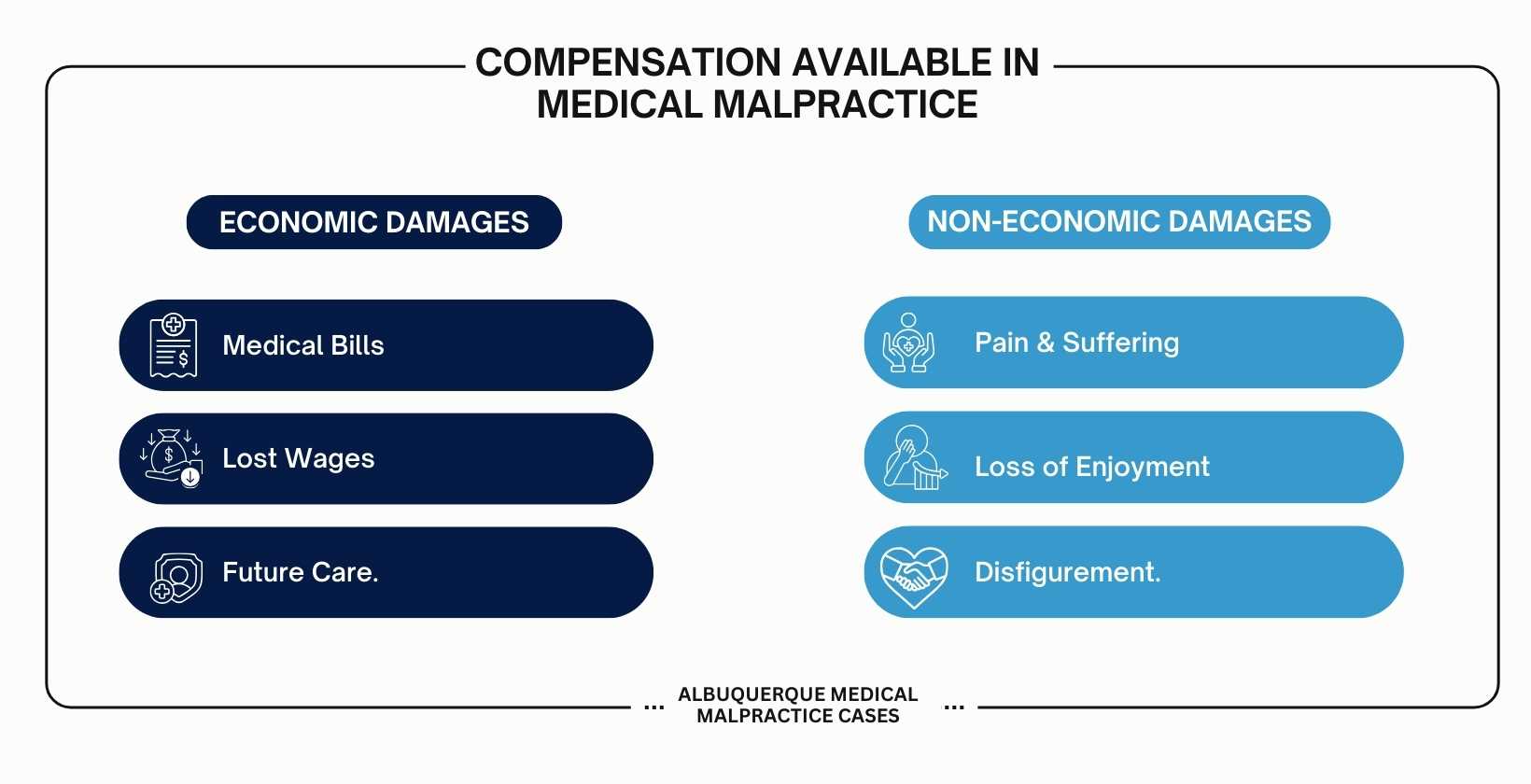
There is no limit to the amount you can recover for tangible financial losses, including:
New Mexico places a cap on damages for pain, suffering, and loss of enjoyment of life. For most claims against Qualified Healthcare Providers, this cap is currently $750,000 (excluding medical bills), though recent legislation provides for annual increases.
It is important to understand how your settlement is funded.
At Collins & Collins, P.C., our team evaluates each claim through a structured, evidence-driven process. We perform a forensic systems audit to identify why a healthcare institution allowed an error to occur, rather than simply blaming a single provider. Our Albuquerque medical malpractice lawyers use a structured, multi-front strategy that begins with Electronic Health Record (EHR) Forensic Auditing to track audit trails and determine if records were altered post-incident. We coordinate with a national network of board-certified specialists to challenge local institutional bias and build a high-stakes, evidence-driven claim.
Our strategy is built on maximizing recovery under the 2026 New Mexico Medical Malpractice Act:
Hospital-Controlled Facilities: We aggressively pursue the $6,000,000 non-economic damage cap available for 2026 claims against hospital systems.
Independent Providers: We navigate the COLA-adjusted caps for private practices, currently exceeding $750,000, and leverage the Patient Compensation Fund (PCF) to secure the full value of your claim.
Systemic Discovery: Our team investigates hospital staffing ratios and corporate budget decisions that prioritize institutional profit over patient safety.
Legislative Advocacy: We stay at the forefront of 2026 updates, including HB 99, to fight for punitive damages under the latest clear and convincing evidentiary standards.
Integrated Estate Recovery: Unlike firms that stop at a settlement check, we provide in-house Probate, Estate Planning, and Special Needs Trusts to protect your recovery funds for the long term.
We simplify complex legal matters by providing clear, concise, and accurate answers to your most pressing questions.
A potential claim exists when medical care deviates from accepted standards, results in injury, and is supported by records or expert findings. Our medical malpractice attorneys evaluate these elements based on the treatment timeline, documentation, and applicable standards of care.
Most medical claims must be filed within three years of the malpractice event or its discovery. However, exceptions and procedural triggers may apply. Early legal review is critical to preserve deadlines and confirm eligibility under New Mexico law.
Not all claims require a Medical Review Panel. In New Mexico, only claims against Qualified Health Care Providers (QHPs) generally need panel review.
Recovery depends on documented economic and non-economic damages, including medical costs, future care, lost income, and pain or suffering.
Contact Collins & Collins, P.C. for a no-obligation case evaluation. We work on a contingency basis, with no upfront costs, and you pay nothing unless we win, to hold negligent providers accountable and secure your recovery.
Call us at (505) 242-5958 or submit your case online to protect your rights.
If you or a loved one has been harmed by negligence, medical malpractice, or injustice in New Mexico, Collins & Collins, P.C. is here to fight for the compensation you deserve. Your first conversation is always free and confidential.
Victim of Systemic Abuse?
We Can Help.
Get a confidential, no-obligation case evaluation from an experienced New Mexico systemic abuse & neglect lawyer.
Or fill out the form
"*" indicates required fields
Available 24/7 Online
Copyright © 2026 – Collins & Collins P.C. All Rights Reserved.
Past results do not guarantee any future outcome, and every case is different.
Collins & Collins, P.C.
Accessibility Statement
Compliance status
We firmly believe that the internet should be available and accessible to anyone, and are committed to providing a website that is accessible to the widest possible audience, regardless of circumstance and ability.
To fulfill this, we aim to adhere as strictly as possible to the World Wide Web Consortium’s (W3C) Web Content Accessibility Guidelines 2.1 (WCAG 2.1) at the AA level. These guidelines explain how to make web content accessible to people with a wide array of disabilities. Complying with those guidelines helps us ensure that the website is accessible to all people: blind people, people with motor impairments, visual impairment, cognitive disabilities, and more.
This website utilizes various technologies that are meant to make it as accessible as possible at all times. We utilize an accessibility interface that allows persons with specific disabilities to adjust the website’s UI (user interface) and design it to their personal needs.
Additionally, the website utilizes an AI-based application that runs in the background and optimizes its accessibility level constantly. This application remediates the website’s HTML, adapts Its functionality and behavior for screen-readers used by the blind users, and for keyboard functions used by individuals with motor impairments.
If you’ve found a malfunction or have ideas for improvement, we’ll be happy to hear from you. You can reach out to the website’s operators by using the following email
Screen-reader and keyboard navigation
Our website implements the ARIA attributes (Accessible Rich Internet Applications) technique, alongside various different behavioral changes, to ensure blind users visiting with screen-readers are able to read, comprehend, and enjoy the website’s functions. As soon as a user with a screen-reader enters your site, they immediately receive a prompt to enter the Screen-Reader Profile so they can browse and operate your site effectively. Here’s how our website covers some of the most important screen-reader requirements, alongside console screenshots of code examples:
Screen-reader optimization: we run a background process that learns the website’s components from top to bottom, to ensure ongoing compliance even when updating the website. In this process, we provide screen-readers with meaningful data using the ARIA set of attributes. For example, we provide accurate form labels; descriptions for actionable icons (social media icons, search icons, cart icons, etc.); validation guidance for form inputs; element roles such as buttons, menus, modal dialogues (popups), and others. Additionally, the background process scans all the website’s images and provides an accurate and meaningful image-object-recognition-based description as an ALT (alternate text) tag for images that are not described. It will also extract texts that are embedded within the image, using an OCR (optical character recognition) technology. To turn on screen-reader adjustments at any time, users need only to press the Alt+1 keyboard combination. Screen-reader users also get automatic announcements to turn the Screen-reader mode on as soon as they enter the website.
These adjustments are compatible with all popular screen readers, including JAWS and NVDA.
Keyboard navigation optimization: The background process also adjusts the website’s HTML, and adds various behaviors using JavaScript code to make the website operable by the keyboard. This includes the ability to navigate the website using the Tab and Shift+Tab keys, operate dropdowns with the arrow keys, close them with Esc, trigger buttons and links using the Enter key, navigate between radio and checkbox elements using the arrow keys, and fill them in with the Spacebar or Enter key.Additionally, keyboard users will find quick-navigation and content-skip menus, available at any time by clicking Alt+1, or as the first elements of the site while navigating with the keyboard. The background process also handles triggered popups by moving the keyboard focus towards them as soon as they appear, and not allow the focus drift outside it.
Users can also use shortcuts such as “M” (menus), “H” (headings), “F” (forms), “B” (buttons), and “G” (graphics) to jump to specific elements.
Disability profiles supported in our website
Additional UI, design, and readability adjustments
Browser and assistive technology compatibility
We aim to support the widest array of browsers and assistive technologies as possible, so our users can choose the best fitting tools for them, with as few limitations as possible. Therefore, we have worked very hard to be able to support all major systems that comprise over 95% of the user market share including Google Chrome, Mozilla Firefox, Apple Safari, Opera and Microsoft Edge, JAWS and NVDA (screen readers).
Notes, comments, and feedback
Despite our very best efforts to allow anybody to adjust the website to their needs. There may still be pages or sections that are not fully accessible, are in the process of becoming accessible, or are lacking an adequate technological solution to make them accessible. Still, we are continually improving our accessibility, adding, updating and improving its options and features, and developing and adopting new technologies. All this is meant to reach the optimal level of accessibility, following technological advancements. For any assistance, please reach out to