
Fired or punished for speaking up? Our Albuquerque whistleblower lawyers protect your rights and seek compensation. Take Action for Justice.
407 7th St NW Albuquerque, NM 87102
info@collinsattorneys.com
Collins & Collins P.C. provides focused representation from experienced Albuquerque Whistleblower Rights Lawyers for individuals across Albuquerque and nearby communities who stepped forward to protect others and were punished for it.
Our whistleblower services include institutional retaliation claims, abuse and neglect reporting, unsafe condition disclosures, and civil rights violations inside government or regulated care facilities. We support inside witnesses throughout New Mexico, from jails and prisons, to foster care agencies, to elder care and medical institutions, and other institutionalized environments where vulnerable people depend entirely on others for safe and lawful treatment.
If you reported wrongdoing and now face pressure, isolation, or efforts to damage your credibility, our team stands with you.
We work to protect your voice, preserve the truth, and keep the institution from rewriting what really happened.
Call us at (505) 242-5958 today for a confidential case review.
Whistleblowing becomes a civil rights case when your report exposes institutional harm, abuse, neglect, unsafe conditions, or a cover-up affecting people who cannot protect themselves, and the institution retaliates. Many clients contact us after reporting these issues and then facing pressure, isolation, or attempts to undermine their credibility. Our job is to identify the civil rights violations involved and protect you from the retaliation that follows. In this context, civil rights refer to the rights to safety, lawful care, and humane treatment inside government facilities or regulated care environments. When a good-faith report threatens to reveal systemic failures, institutions often shift from addressing the problem to silencing the inside witness. That is when our team starts building the record needed to hold the institution accountable.
This shift is most common in settings where vulnerable or confined people rely entirely on others for protection, including:
Jails and prisons
Excessive force, denial of medical care, unsafe housing, manipulated or incomplete incident reports
Ignored maltreatment reports, unsafe placements, pressure to modify documentation
Elder care facilities
Neglect tied to staffing decisions, misuse of restraints, medication errors, and altered charts
Medical institutions
Unsafe clinical practices, coerced discharges, manipulated patient records, retaliation after safety complaints
Understanding whether your situation involves civil rights whistleblowing, rather than a workplace dispute, is the first step in choosing the right legal strategy. As whistleblower attorneys in Albuquerque, NM, we help you make that distinction, preserve key evidence, and address the retaliation institutions use to silence inside witnesses.
If you or a loved one has suffered severe permanent harm or death please call 505-242-5958 or complete our Case Review Form
When our clients have reported abuse, neglect, unsafe conditions, or a cover-up, institutions often respond quickly with retaliation. Clients may see sudden write-ups, reassignment, loss of access, or pressure to stay quiet. In institutional settings, these actions may trigger protections under New Mexico whistleblower law or civil rights statutes, depending on whether the facility is public or privately operated.
Institutions may frame their response as “policy” or “performance,” but those labels do not decide the legal analysis. What matters is the timing, the shift in how you are treated, and whether documentation, incident reports, logs, charts, or staff statements begin to change in ways that suggest an effort to conceal wrongdoing.
Protections and claims that may apply include:
This analysis guides how our Albuquerque whistleblower rights attorneys evaluate your situation and determine which protections and claims may apply inside institutional systems.
Before you report abuse, neglect, unsafe conditions, or a cover-up, you should take these steps to protect your record and your employee whistleblower rights in New Mexico. Institutions control most of the evidence, which makes preparation essential.
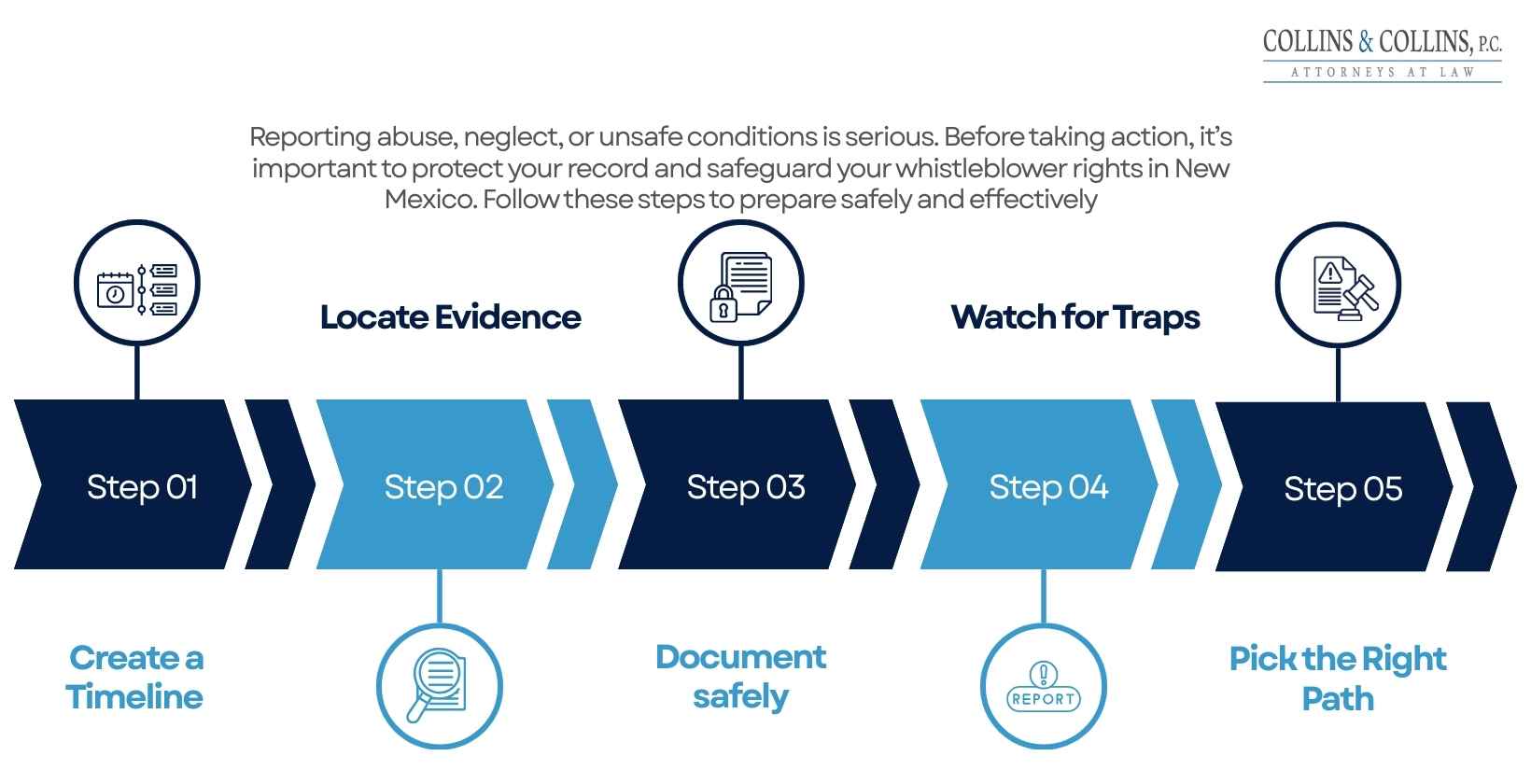
1. Create a clear timeline
Record dates, locations, what you observed, who was present, and when you raised concerns. A timeline strengthens your credibility.
2. Map where the evidence is kept
Identify where video, logs, charts, staffing records, and incident reports are stored and who controls access. You are locating the evidence trail, not removing documents.
3. Document safely
Keep a private factual log without protected health information or resident identifiers. Do not store notes on employer systems.
4. Watch for confidentiality traps
Requests for “clarifications,” quick statements, or informal meetings can be used to narrow or contradict your report. In medical and elder care settings, certain questions may also create privacy risks.
5. Choose your reporting pathway strategically
Internal reporting may work when leadership is not involved. External reporting is safer when there is a risk of retaliation, evidence manipulation, or harm to vulnerable individuals.
When you report dangerous conditions, care failures, or efforts to hide misconduct, retaliation can follow quickly. At Collins & Collins P.C., our legal team steps in early to protect our clients’ records and confront the systems that fuel whistleblower retaliation claims inside government and regulated facilities. Many clients reach out after noticing shifts in treatment or changes in documentation. We help our clients document these patterns and connect them to the institutional failures driving the retaliation.
How we help:
Our team knows how to hold institutions accountable when they rely on pressure or silence to avoid scrutiny. If you’re facing retaliation, contact us today so we can intervene before more evidence shifts or disappears.
We simplify complex legal matters by providing clear, concise, and accurate answers to your most pressing questions.
Yes, you can report misconduct anonymously without being identified, but anonymity often fades once retaliation begins. To report misconduct anonymously with safer protections, our whistleblower retaliation lawyer Albuquerque team helps our client’s plan the first steps.
Yes, you can still have a case if the institution says it was “performance” or “policy.” Institutions often use “performance” or “policy” explanations to cover retaliation, and our best whistleblower lawyers in Albuquerque examine timing and documentation shifts.
No, you do not need evidence before reporting institutional abuse or neglect. You can report institutional abuse or neglect based on what you witnessed, and we help identify where records may exist and how to preserve them without risking retaliation.
Yes, you can be protected if you’re a contractor. Contractor retaliation cases often qualify when you report unsafe conditions or misconduct, and we review your contract and facility control to determine which protections apply.
If you already reported internally and it got worse, that pattern often supports a retaliation claim. When internal reporting gets worse, we document the escalation and determine how to move your case forward.
No, you do not have to be an employee to file a whistleblower case. You may file a whistleblower case as a contractor or volunteer, and our federal whistleblower lawyers in Albuquerque will review which protections apply.
If you work at a government facility or a public contractor, your case may involve federal protections. Working at a government facility or public contractor often expands your options under federal whistleblower protection standards.
It depends. Whether you report internally first or go to an outside agency changes with retaliation risk and leadership involvement. We help you choose the safer reporting path based on what you’ve seen.
If you or a loved one has been harmed by negligence, medical malpractice, or injustice in New Mexico, Collins & Collins, P.C. is here to fight for the compensation you deserve. Your first conversation is always free and confidential.
Victim of Systemic Abuse?
We Can Help.
Get a confidential, no-obligation case evaluation from an experienced New Mexico systemic abuse & neglect lawyer.
Or fill out the form
"*" indicates required fields
Available 24/7 Online
Copyright © 2026 – Collins & Collins P.C. All Rights Reserved.
Past results do not guarantee any future outcome, and every case is different.
Collins & Collins, P.C.
Accessibility Statement
Compliance status
We firmly believe that the internet should be available and accessible to anyone, and are committed to providing a website that is accessible to the widest possible audience, regardless of circumstance and ability.
To fulfill this, we aim to adhere as strictly as possible to the World Wide Web Consortium’s (W3C) Web Content Accessibility Guidelines 2.1 (WCAG 2.1) at the AA level. These guidelines explain how to make web content accessible to people with a wide array of disabilities. Complying with those guidelines helps us ensure that the website is accessible to all people: blind people, people with motor impairments, visual impairment, cognitive disabilities, and more.
This website utilizes various technologies that are meant to make it as accessible as possible at all times. We utilize an accessibility interface that allows persons with specific disabilities to adjust the website’s UI (user interface) and design it to their personal needs.
Additionally, the website utilizes an AI-based application that runs in the background and optimizes its accessibility level constantly. This application remediates the website’s HTML, adapts Its functionality and behavior for screen-readers used by the blind users, and for keyboard functions used by individuals with motor impairments.
If you’ve found a malfunction or have ideas for improvement, we’ll be happy to hear from you. You can reach out to the website’s operators by using the following email
Screen-reader and keyboard navigation
Our website implements the ARIA attributes (Accessible Rich Internet Applications) technique, alongside various different behavioral changes, to ensure blind users visiting with screen-readers are able to read, comprehend, and enjoy the website’s functions. As soon as a user with a screen-reader enters your site, they immediately receive a prompt to enter the Screen-Reader Profile so they can browse and operate your site effectively. Here’s how our website covers some of the most important screen-reader requirements, alongside console screenshots of code examples:
Screen-reader optimization: we run a background process that learns the website’s components from top to bottom, to ensure ongoing compliance even when updating the website. In this process, we provide screen-readers with meaningful data using the ARIA set of attributes. For example, we provide accurate form labels; descriptions for actionable icons (social media icons, search icons, cart icons, etc.); validation guidance for form inputs; element roles such as buttons, menus, modal dialogues (popups), and others. Additionally, the background process scans all the website’s images and provides an accurate and meaningful image-object-recognition-based description as an ALT (alternate text) tag for images that are not described. It will also extract texts that are embedded within the image, using an OCR (optical character recognition) technology. To turn on screen-reader adjustments at any time, users need only to press the Alt+1 keyboard combination. Screen-reader users also get automatic announcements to turn the Screen-reader mode on as soon as they enter the website.
These adjustments are compatible with all popular screen readers, including JAWS and NVDA.
Keyboard navigation optimization: The background process also adjusts the website’s HTML, and adds various behaviors using JavaScript code to make the website operable by the keyboard. This includes the ability to navigate the website using the Tab and Shift+Tab keys, operate dropdowns with the arrow keys, close them with Esc, trigger buttons and links using the Enter key, navigate between radio and checkbox elements using the arrow keys, and fill them in with the Spacebar or Enter key.Additionally, keyboard users will find quick-navigation and content-skip menus, available at any time by clicking Alt+1, or as the first elements of the site while navigating with the keyboard. The background process also handles triggered popups by moving the keyboard focus towards them as soon as they appear, and not allow the focus drift outside it.
Users can also use shortcuts such as “M” (menus), “H” (headings), “F” (forms), “B” (buttons), and “G” (graphics) to jump to specific elements.
Disability profiles supported in our website
Additional UI, design, and readability adjustments
Browser and assistive technology compatibility
We aim to support the widest array of browsers and assistive technologies as possible, so our users can choose the best fitting tools for them, with as few limitations as possible. Therefore, we have worked very hard to be able to support all major systems that comprise over 95% of the user market share including Google Chrome, Mozilla Firefox, Apple Safari, Opera and Microsoft Edge, JAWS and NVDA (screen readers).
Notes, comments, and feedback
Despite our very best efforts to allow anybody to adjust the website to their needs. There may still be pages or sections that are not fully accessible, are in the process of becoming accessible, or are lacking an adequate technological solution to make them accessible. Still, we are continually improving our accessibility, adding, updating and improving its options and features, and developing and adopting new technologies. All this is meant to reach the optimal level of accessibility, following technological advancements. For any assistance, please reach out to