407 7th St NW Albuquerque, NM 87102
in**@**************ys.com
Collins & Collins, P.C. serves families statewide as a New Mexico foster care sexual abuse lawyer team focused on holding CYFD and foster care agencies accountable for institutional failures. Our work in civil rights litigation and cases involving prison abuse and systemic neglect gives us the experience to uncover ignored warnings, expose oversight breakdowns, and confront the government decisions that allowed the harm to occur. We take a direct, plain-spoken approach consistent with Albuquerque’s legal standards, and we pursue litigation that forces transparency, answers, and long-overdue accountability.
Contact us at 505-242-5958 so we can act quickly and protect your rights before key deadlines pass.
As a sexual abuse law firm experienced in institutional-failure cases, we understand how to challenge CYFD, contracted agencies, and other government personnel when oversight collapses. Our background in statewide civil rights and government-accountability litigation has earned us a strong reputation for navigating complex public-sector systems, securing access to internal records, and bringing clarity to patterns of neglect that allowed harm to occur. Our litigation style is direct, precise, and consistent with how serious cases move through New Mexico courts.
What sets our team apart:
Our team evaluates how CYFD, foster agencies, and their contracted providers handled their responsibilities, focusing on the choices, communication patterns, and supervisory actions that shaped each placement. By examining how various parts of New Mexico’s public-sector oversight operated, we isolate the institutional breakdowns that support a strong civil claim and demonstrate where the system failed to protect the child.
Core components of our investigative work:
Securing placement histories, agency files, and internal documentation through formal requests
Compelling production of emails, caseworker logs, and internal communications
Bringing in subject-matter experts to assess policies, supervision standards, and regulatory compliance
Conducting institutional analyses to identify structural weaknesses and unsafe practices
Building precise timelines that reveal how decision-making duties and omissions aligned with the harm
As sex abuse attorneys handling foster care cases, we establish entity negligence by examining whether placement agencies and contracted supervisors followed the required standards and statutory obligations. Our focus is on assessing hiring decisions, supervision practices, and how each organization responded to information that should have triggered action.
By reviewing documented responsibilities against actual decisions, we identify where safeguards were bypassed or ignored. Through this comparison, we identify specific points where mandatory safeguards were bypassed or ignored. This targeted approach supports government liability claims and allows us to move forward with litigation built on clear institutional violations.
We pursue civil actions against the organizations and individuals responsible for allowing unsafe foster placements to continue. Our focus is on identifying which entities held legal duties during the placement and determining where those responsibilities broke down under New Mexico law.
Entities that may face liability include:
Our lawyers build proof by collecting documentation that shows how agencies handled the placement and what information was available to them before the harm occurred. These records help establish the institutional decisions and missed indicators that form the basis of a civil claim.
Key forms of evidence we analyze include:
1. Placement records outlining movement, supervision, and assigned responsibilities
2. CYFD investigation files and internal reviews related to the placement
3. Communication logs between agencies, contractors, and supervisory staff
4. Medical and psychological evaluations that document harm and related findings
6. Complaint histories involving caregivers, facilities, or contracted personnel
7. Facility safety audits and compliance reports
8. Records from contracted oversight providers
This documented proof strengthens the legal arguments we advance in pursuing accountability.
A comprehensive damage assessment begins with identifying both the financial and non-financial losses tied to the abuse and documenting each category for negotiations and litigation. Our work focuses on defining measurable impacts, projecting long-term needs, and presenting a clear damages framework that supports a strong civil claim for child abuse under New Mexico law.
These documented losses support a clear, evidence-backed demand for full compensation.
As lawyers for sexual abuse cases involving foster placements, Collins & Collins, P.C. focuses on identifying the liability theories that hold private agencies and contracted providers accountable for systemic failures. Our team analyzes agency conduct, applies governing precedent, and builds claims that highlight where supervision, staffing, and safety obligations were mishandled under New Mexico law.
Types of civil actions we pursue include:
Negligent supervision claims targeting breakdowns in monitoring, oversight, and safety controls
Improper placement decisions involving placements made without adequate safety review
Hiring and retention failures involving agencies that failed to vet, train, or remove unfit personnel
Failure to act claims involving situations where known risks or prior warnings were disregarded
Section 1983 civil rights violations apply when state personnel violate federally protected rights
Claims against contracted providers holding third-party agencies responsible for misconduct tied to their duties.
Claims against CYFD and other public entities in New Mexico follow strict statutory timelines under the New Mexico Tort Claims Act. These deadlines apply in many foster care abuse cases because state agencies and state-contracted providers are often involved. Missing the required timing bars the claim entirely, regardless of its merits.
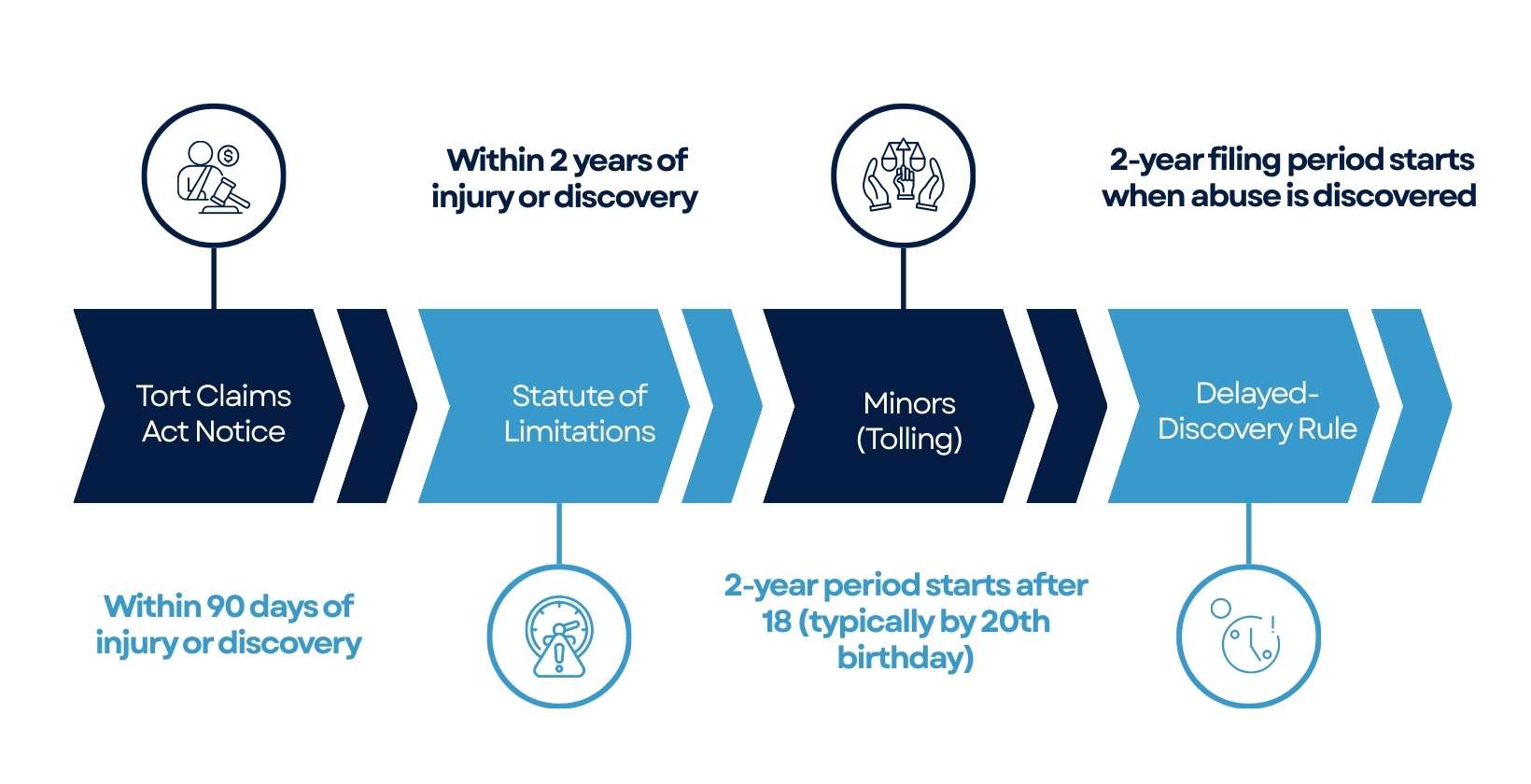
Key Statutory Timing Rules:
As these deadlines are rigid and jurisdictional, immediate legal action is critical to preserve the right to file a civil claim.
Each case is guided through a structured litigation plan that keeps communication consistent, documentation organized, and progress clearly mapped from start to finish. This coordinated approach ensures the legal work remains steady and deliberate, creating a smooth transition into the broader strategy and results that follow.
Recognized among the best sexual assault lawyer teams handling institutional negligence in New Mexico, the practice investigates abuse across a range of state-run and state-contracted environments. Experience with these systems provides a detailed understanding of how liability operates within different placements and facilities across the state.
Institutional settings commonly examined include:
This range reflects the practice’s broad capacity to identify systemic failures across multiple institutional settings.
Recent results from Collins & Collins, P.C. in complex institutional abuse and civil rights cases show a consistent record of holding government agencies and contractors accountable for systemic failures across New Mexico.
$6.9M
Settlement procured after an incarcerated individual died during unmanaged opioid withdrawal due to failures by jail and medical staff.
$1.6M
Civil rights settlement for an inmate with severe mental illness who died by suicide following inadequate mental-health oversight.
“Note: Past results do not guarantee any future outcome, and every case is different.”
Very professional & knowledgeable. Gave a very detailed description of legal proceedings. And very positive.
Susanna HerreraWe simplify complex legal matters by providing clear, concise, and accurate answers to your most pressing questions.
Yes, foster care sexual abuse cases are handled in both civil court and criminal court. Civil court addresses compensation and agency negligence, while the criminal court prosecutes the offender. Each process runs independently but can occur at the same time.
Yes, attorneys can handle civil claims while a criminal case is still pending, because civil litigation focuses on agency liability, supervision failures, and damages, which proceed separately from criminal prosecution.
If abuse is suspected in a foster home, reporting it to the proper authorities is required under New Mexico law, and civil attorneys can then evaluate how the agency responded to determine whether inaction supports a claim.
Yes. Collins & Collins, P.C. takes cases involving group homes or shelters because group homes and shelters operate under the same CYFD-contracted supervision duties, making abuse in these settings actionable through the same civil frameworks used in foster care claims.
Foster care abuse cases differ from other abuse claims because the legal framework involves CYFD oversight, state-agency duties, contracted provider obligations, and placement decisions, creating multiple layers of potential liability not found in standard abuse cases.
As foster care abuse attorneys at Collins & Collins, P.C., our work centers on enforcing agency accountability and exposing the systemic failures that allowed the harm to occur, each case we pursue strengthens oversight across New Mexico’s foster care system and supports long-term protections for children statewide.
Available 24/7 Online
Copyright © 2025 – Collins & Collins P.C. All Rights Reserved.
Past results do not guarantee any future outcome, and every case is different.
Collins & Collins, P.C.
We firmly believe that the internet should be available and accessible to anyone, and are committed to providing a website that is accessible to the widest possible audience, regardless of circumstance and ability.
To fulfill this, we aim to adhere as strictly as possible to the World Wide Web Consortium’s (W3C) Web Content Accessibility Guidelines 2.1 (WCAG 2.1) at the AA level. These guidelines explain how to make web content accessible to people with a wide array of disabilities. Complying with those guidelines helps us ensure that the website is accessible to all people: blind people, people with motor impairments, visual impairment, cognitive disabilities, and more.
This website utilizes various technologies that are meant to make it as accessible as possible at all times. We utilize an accessibility interface that allows persons with specific disabilities to adjust the website’s UI (user interface) and design it to their personal needs.
Additionally, the website utilizes an AI-based application that runs in the background and optimizes its accessibility level constantly. This application remediates the website’s HTML, adapts Its functionality and behavior for screen-readers used by the blind users, and for keyboard functions used by individuals with motor impairments.
If you’ve found a malfunction or have ideas for improvement, we’ll be happy to hear from you. You can reach out to the website’s operators by using the following email
Our website implements the ARIA attributes (Accessible Rich Internet Applications) technique, alongside various different behavioral changes, to ensure blind users visiting with screen-readers are able to read, comprehend, and enjoy the website’s functions. As soon as a user with a screen-reader enters your site, they immediately receive a prompt to enter the Screen-Reader Profile so they can browse and operate your site effectively. Here’s how our website covers some of the most important screen-reader requirements, alongside console screenshots of code examples:
Screen-reader optimization: we run a background process that learns the website’s components from top to bottom, to ensure ongoing compliance even when updating the website. In this process, we provide screen-readers with meaningful data using the ARIA set of attributes. For example, we provide accurate form labels; descriptions for actionable icons (social media icons, search icons, cart icons, etc.); validation guidance for form inputs; element roles such as buttons, menus, modal dialogues (popups), and others. Additionally, the background process scans all the website’s images and provides an accurate and meaningful image-object-recognition-based description as an ALT (alternate text) tag for images that are not described. It will also extract texts that are embedded within the image, using an OCR (optical character recognition) technology. To turn on screen-reader adjustments at any time, users need only to press the Alt+1 keyboard combination. Screen-reader users also get automatic announcements to turn the Screen-reader mode on as soon as they enter the website.
These adjustments are compatible with all popular screen readers, including JAWS and NVDA.
Keyboard navigation optimization: The background process also adjusts the website’s HTML, and adds various behaviors using JavaScript code to make the website operable by the keyboard. This includes the ability to navigate the website using the Tab and Shift+Tab keys, operate dropdowns with the arrow keys, close them with Esc, trigger buttons and links using the Enter key, navigate between radio and checkbox elements using the arrow keys, and fill them in with the Spacebar or Enter key.Additionally, keyboard users will find quick-navigation and content-skip menus, available at any time by clicking Alt+1, or as the first elements of the site while navigating with the keyboard. The background process also handles triggered popups by moving the keyboard focus towards them as soon as they appear, and not allow the focus drift outside it.
Users can also use shortcuts such as “M” (menus), “H” (headings), “F” (forms), “B” (buttons), and “G” (graphics) to jump to specific elements.
We aim to support the widest array of browsers and assistive technologies as possible, so our users can choose the best fitting tools for them, with as few limitations as possible. Therefore, we have worked very hard to be able to support all major systems that comprise over 95% of the user market share including Google Chrome, Mozilla Firefox, Apple Safari, Opera and Microsoft Edge, JAWS and NVDA (screen readers).
Despite our very best efforts to allow anybody to adjust the website to their needs. There may still be pages or sections that are not fully accessible, are in the process of becoming accessible, or are lacking an adequate technological solution to make them accessible. Still, we are continually improving our accessibility, adding, updating and improving its options and features, and developing and adopting new technologies. All this is meant to reach the optimal level of accessibility, following technological advancements. For any assistance, please reach out to
Collins & Collins, PC are amazing attorneys! They became my top choice in Albuquerque. They truly respect your rights and work hard for you. Special thanks to Parrish and the team for supporting me through the loss of my son. I’m so grateful for their dedication and hard work on my case. I highly recommend them to anyone looking for a compassionate and skilled attorney. They earned a 10-star rating in my book!
Trini Encinias