407 7th St NW Albuquerque, NM 87102
info@collinsattorneys.com
Every elder in our communities deserves honour, safety, dignity, and respect. When those rights are violated, legal action can restore them and prevent further harm.
At Collins & Collins, P.C., our experienced New Mexico elder abuse attorneys help families protect their loved ones and pursue justice against negligent nursing homes, hospitals, and long-term care facilities. We provide clear answers, decisive action, and compassionate guidance every step of the way.
With a proven record in elder law, civil litigation, and institutional accountability, our attorneys are dedicated to creating safer care environments across New Mexico. If your loved one has suffered abuse or neglect, we’re here to help you take confident, informed legal action.
Contact us today for a private, no-cost case review.
If you or a loved one has suffered severe permanent harm or death please call 505-242-5958 or complete our Case Review Form
Taking immediate legal action is the first step toward protecting your loved one and uncovering the truth. Our confidential case reviews give your family clear answers, a safe place to talk about what’s happening, and a roadmap for what to do next. Early legal involvement can strengthen your claim, expose patterns of abuse or neglect, and help stop the harm before it gets worse.
Key benefits of acting now:
Call 505-578-2805 or submit a secure online form to speak directly with an attorney today.
We stand up for elder abuse victims and their families across New Mexico, with a focus on earning our clients real results, accountability, and long-term protection. Whether the harm occurs in a nursing home, hospital, assisted living facility, or other care setting, our litigation team is equipped to handle complex cases against institutions at every level.
What sets us apart:
Courtroom-tested in high-stakes elder abuse and neglect claims. We prepare every case as if it will go to trial, using evidence, experts, and strategy to demand full accountability.
Legal strategies tailored to each client’s safety and well-being. Your loved one’s health, dignity, and security guide every decision we make.
Leadership in exposing systemic abuse in institutional care. We look beyond a single incident to uncover patterns of neglect, understaffing, or unsafe practices.
Clear, consistent communication from consultation to resolution. You’ll always know where your case stands, what comes next, and why it matters.
We take swift and direct legal action against nursing homes, hospitals, group homes, and long-term care facilities that allow, ignore, or conceal elder abuse. When residents are harmed through neglect, understaffing, unsafe policies, or deliberate misconduct, we move quickly to investigate what happened, identify every responsible party, and build a case grounded in medical records, internal documents, and expert testimony. Our goal is not only to secure justice and compensation for your family, but also to force institutional change, holding owners, administrators, and corporate leadership accountable so the same failures are not repeated with someone else’s loved one.
We bring civil lawsuits against care facilities and institutions that violate basic elder safety standards. Our legal team investigates negligence at every level, from front-line staff to corporate ownership, pursuing cases that demand accountability, compensation, and long-term protection for victims and their families.
We litigate claims involving:

We’re prepared to act quickly on behalf of any senior citizen harmed by institutional neglect, abuse, or systemic shortcomings.
We are fully equipped to handle high-stakes elder abuse and neglect cases involving institutional failures, corporate negligence, and severe harm to vulnerable residents. Our strategy is straightforward and uncompromising: build strong, evidence-driven claims that can withstand courtroom scrutiny and create real leverage at the negotiation table.
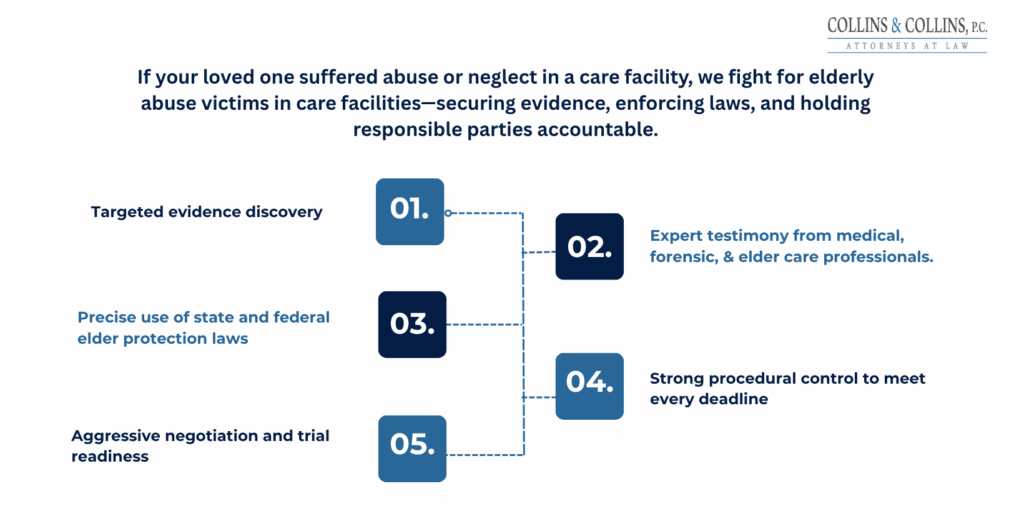
Our litigation approach includes:
We enter into every case prepared to litigate with strength, focus, and purpose, so your family is never fighting this battle alone.
We pursue maximum compensation for victims of elder abuse and neglect, holding facilities and institutions financially accountable for the harm they cause. Our focus is simple: secure full, lawful compensation so your loved one can access proper care, regain stability, and reclaim their dignity.
Types of damages we seek include:
Economic damages
Current and future medical expenses, relocation costs, and long-term care needs.
Non-economic damages
Pain, suffering, humiliation, and loss of dignity caused by abuse or neglect.
Punitive damages
Financial penalties in cases of reckless, willful, or deliberate misconduct.
Common recoverable losses include:
We fight for every dollar your family is entitled to receive under New Mexico law, so you can begin rebuilding with security and peace of mind.
We provide full-service legal representation from the moment you contact us through the final resolution of your case. Our approach is built on transparency, accessibility, and a trauma-informed strategy that respects the needs of elder abuse victims and the families fighting for them. From the first investigation steps to negotiation, and then trial in a court of law when needed, we stay by your side with clear and direct communication focused on protecting your loved one.
What you can expect from our legal team:
At every stage of your case, you remain supported, informed, and protected by our team.
We use every legal pathway available under New Mexico law and federal statutes to hold individuals, institutions, and government agencies accountable for elder abuse. The Collins & Collins team routinely relies on the Adult Protective Services Act, the New Mexico Civil Rights Act, and Section 1983 federal claims to expose systemic failures and enforce meaningful accountability.
These statutes allow us to pursue civil actions against state-run hospitals, publicly funded nursing homes, and other care facilities that violate an elder’s constitutional and statutory rights. In many cases, we have used Section 1983 to bring claims against government entities that failed to protect vulnerable elders in their care.
At Collins & Collins, P.C., our results reflect a deep commitment to holding negligent facilities accountable through focused, strategic litigation, not quick, low-value settlements. We’ve secured meaningful outcomes for families across New Mexico by building strong, evidence-backed cases that demand justice and real change inside abusive institutions.
Notable outcomes include:
Contact us today to discuss your potential elder abuse claim and how our experience may help your family.
We simplify complex legal matters by providing clear, concise, and accurate answers to your most pressing questions.
No. A successful elder abuse claim in New Mexico does not always require going to court. Many elder abuse lawsuits are resolved through settlements before trial, but we prepare each case to succeed in court if necessary.
It depends. If elder abuse occurred years ago but was never reported, you may still file a claim under New Mexico’s discovery rule if the harm was identified later. Legal timelines vary based on when the abuse was reasonably discovered.
To hire a New Mexico elder abuse lawyer, there are no upfront fees. We work on a contingency fee basis, meaning you pay nothing unless your elder abuse case results in compensation through settlement or verdict.
Yes. You can file a civil elder abuse claim in New Mexico even if no criminal charges were filed. Civil claims focus on financial compensation and have a lower burden of proof than criminal prosecution.
Evidence that supports an elder abuse lawsuit in New Mexico includes medical records, witness statements, inspection reports, injury photographs, and caregiver logs. This documentation helps prove neglect or abuse occurred and supports legal accountability.
Recognizing the signs of elder abuse is the first step. The next and most important is asserting your loved one’s rights under New Mexico law. With clear legal guidance, families can move from quiet concern to decisive action, and from fear to accountability. Understanding your legal position opens the door to real protection, justice, and long-term change for the elder in your care.
Call 505-242-5958 today to begin a confidential review of your potential elder abuse case.
"*" indicates required fields
Available 24/7 Online
Copyright © 2025 – Collins & Collins P.C. All Rights Reserved.
Past results do not guarantee any future outcome, and every case is different.
Collins & Collins, P.C.
Accessibility Statement
Compliance status
We firmly believe that the internet should be available and accessible to anyone, and are committed to providing a website that is accessible to the widest possible audience, regardless of circumstance and ability.
To fulfill this, we aim to adhere as strictly as possible to the World Wide Web Consortium’s (W3C) Web Content Accessibility Guidelines 2.1 (WCAG 2.1) at the AA level. These guidelines explain how to make web content accessible to people with a wide array of disabilities. Complying with those guidelines helps us ensure that the website is accessible to all people: blind people, people with motor impairments, visual impairment, cognitive disabilities, and more.
This website utilizes various technologies that are meant to make it as accessible as possible at all times. We utilize an accessibility interface that allows persons with specific disabilities to adjust the website’s UI (user interface) and design it to their personal needs.
Additionally, the website utilizes an AI-based application that runs in the background and optimizes its accessibility level constantly. This application remediates the website’s HTML, adapts Its functionality and behavior for screen-readers used by the blind users, and for keyboard functions used by individuals with motor impairments.
If you’ve found a malfunction or have ideas for improvement, we’ll be happy to hear from you. You can reach out to the website’s operators by using the following email
Screen-reader and keyboard navigation
Our website implements the ARIA attributes (Accessible Rich Internet Applications) technique, alongside various different behavioral changes, to ensure blind users visiting with screen-readers are able to read, comprehend, and enjoy the website’s functions. As soon as a user with a screen-reader enters your site, they immediately receive a prompt to enter the Screen-Reader Profile so they can browse and operate your site effectively. Here’s how our website covers some of the most important screen-reader requirements, alongside console screenshots of code examples:
Screen-reader optimization: we run a background process that learns the website’s components from top to bottom, to ensure ongoing compliance even when updating the website. In this process, we provide screen-readers with meaningful data using the ARIA set of attributes. For example, we provide accurate form labels; descriptions for actionable icons (social media icons, search icons, cart icons, etc.); validation guidance for form inputs; element roles such as buttons, menus, modal dialogues (popups), and others. Additionally, the background process scans all the website’s images and provides an accurate and meaningful image-object-recognition-based description as an ALT (alternate text) tag for images that are not described. It will also extract texts that are embedded within the image, using an OCR (optical character recognition) technology. To turn on screen-reader adjustments at any time, users need only to press the Alt+1 keyboard combination. Screen-reader users also get automatic announcements to turn the Screen-reader mode on as soon as they enter the website.
These adjustments are compatible with all popular screen readers, including JAWS and NVDA.
Keyboard navigation optimization: The background process also adjusts the website’s HTML, and adds various behaviors using JavaScript code to make the website operable by the keyboard. This includes the ability to navigate the website using the Tab and Shift+Tab keys, operate dropdowns with the arrow keys, close them with Esc, trigger buttons and links using the Enter key, navigate between radio and checkbox elements using the arrow keys, and fill them in with the Spacebar or Enter key.Additionally, keyboard users will find quick-navigation and content-skip menus, available at any time by clicking Alt+1, or as the first elements of the site while navigating with the keyboard. The background process also handles triggered popups by moving the keyboard focus towards them as soon as they appear, and not allow the focus drift outside it.
Users can also use shortcuts such as “M” (menus), “H” (headings), “F” (forms), “B” (buttons), and “G” (graphics) to jump to specific elements.
Disability profiles supported in our website
Additional UI, design, and readability adjustments
Browser and assistive technology compatibility
We aim to support the widest array of browsers and assistive technologies as possible, so our users can choose the best fitting tools for them, with as few limitations as possible. Therefore, we have worked very hard to be able to support all major systems that comprise over 95% of the user market share including Google Chrome, Mozilla Firefox, Apple Safari, Opera and Microsoft Edge, JAWS and NVDA (screen readers).
Notes, comments, and feedback
Despite our very best efforts to allow anybody to adjust the website to their needs. There may still be pages or sections that are not fully accessible, are in the process of becoming accessible, or are lacking an adequate technological solution to make them accessible. Still, we are continually improving our accessibility, adding, updating and improving its options and features, and developing and adopting new technologies. All this is meant to reach the optimal level of accessibility, following technological advancements. For any assistance, please reach out to