

Prisoners do not surrender their constitutional rights at the jailhouse door. People held in prisons, jails, and detention facilities retain legal protections under the U.S. Constitution, including the right to humane treatment, adequate medical care, and protection from abuse or excessive force. These protections arise from the Eighth Amendment, which prohibits cruel and unusual punishment, and the Fourteenth Amendment, which safeguards individuals held before trial.
When correctional institutions ignore these rights through medical neglect, physical abuse, or dangerous living conditions, civil rights law provides a path to accountability. Federal laws, including 42 U.S.C. §1983, allow individuals in custody, and their families, to hold government officials responsible for unconstitutional conduct.
If someone you love is in custody and you believe their rights were violated, a New Mexico prison abuse attorney can help you understand your legal options.
Key Takeaways
- Prisoners retain constitutional rights under the Eighth and Fourteenth Amendments even while incarcerated.
- Medical neglect, excessive force, unsafe conditions, and retaliation are recognized civil rights violations.
- Families can file civil rights claims on behalf of a loved one harmed or killed in custody.
- The New Mexico Civil Rights Act removes qualified immunity and mandates attorney fees if a claim is successful.
- Both federal and New Mexico claims carry a three-year statute of limitations; acting early is critical.
Key Constitutional Rights That Protect Prisoners and Detainees
Constitutional protections do not stop at the prison gate. Courts apply different legal standards depending on custody status – the Eighth Amendment governs convicted prisoners, while the Fourteenth Amendment protects individuals held before trial. These distinctions define what correctional facilities are legally required to provide and what they are prohibited from doing.
- Protection against cruel and unusual punishment (Eighth Amendment): Convicted prisoners cannot be subjected to inhumane treatment. This includes excessive force by staff, denial of necessary medical care, dangerous living conditions, and prolonged solitary confinement. When a facility knowingly ignores a serious risk to health or safety, that failure may constitute a constitutional violation.
- Due process protections for pretrial detainees (Fourteenth Amendment): People awaiting trial have not been convicted and cannot be punished as though they have. Jail conditions must serve a legitimate security or operational purpose. Punitive conditions imposed before conviction violate due process regardless of the charges a person faces.
- Right to practice religion: Incarcerated individuals retain the right to practice their religion, subject to reasonable restrictions that serve legitimate security needs. Facilities cannot arbitrarily deny religious materials, services, or observance without justification.
- Right to communicate with legal counsel and courts: People in custody have a constitutionally protected right to access the courts and communicate with their attorneys. Interference with legal mail, denial of attorney access, or obstruction of court filings can constitute a separate civil rights violation.
Laws That Protect Prisoners’ Civil Rights in New Mexico
Several federal and state laws create legal pathways to address unconstitutional conditions in New Mexico prisons and jails.
- Civil Rights of Institutionalized Persons Act (CRIPA): Allows the Department of Justice to investigate facilities for systemic violations, including abuse, unsafe conditions, and denial of medical care. A DOJ investigation into a facility can be significant evidence of systemic failure.
- Section 1983 Civil Rights Claims: The primary federal tool for holding government officials accountable. Allows individuals in custody and their families to sue state or local officials for constitutional violations, including excessive force, medical neglect, and retaliation.
- Prison Litigation Reform Act (PLRA): Requires incarcerated individuals to exhaust all internal grievance processes before filing a federal lawsuit. Failing to do so can result in dismissal regardless of how serious the violation was. Grievance records should always be preserved.
- Disability Rights Laws (ADA and Rehabilitation Act): Require correctional facilities to provide equal access and reasonable accommodations for people with physical or mental disabilities.
- New Mexico Civil Rights Act (NMCRA): New Mexico law provides an additional layer of protection beyond federal civil rights claims. The NMCRA allows individuals to sue a public body, including correctional facilities, for violations of rights guaranteed under the New Mexico Constitution. Unlike federal law, qualified immunity cannot be used as a defense. Claims carry a three-year statute of limitations, a $2 million damages cap, and mandatory attorney fees if successful.

Common Prisoners’ Rights Violations in Correctional Facilities In New Mexico
Prisoners’ rights violations often occur when detention institutions fail to meet constitutional standards for safety, medical care, and humane treatment. These failures can expose incarcerated individuals to serious harm and may constitute constitutional or civil rights violations when basic protections are ignored.
Medical Neglect and Delayed Treatment
Medical neglect occurs when prison or jail staff ignore reported symptoms, delay necessary treatment, or deny access to a doctor. Under the Eighth Amendment, facilities are required to respond to serious medical needs, and a knowing failure to do so may constitute deliberate indifference, a recognized civil rights violation.
Common examples include untreated infections, ignored chest pain, delayed diagnosis, and denial of prescribed medication. These are not minor oversights; they can result in permanent injury or death.
If your loved one’s medical complaints were repeatedly dismissed or their condition worsened without treatment, that pattern may indicate a civil rights violation.
Mental Health Neglect and Suicide Prevention Failures
Many correctional facilities lack adequate psychiatric care despite housing large numbers of people with serious mental health conditions. Deliberate indifference to a psychiatric condition, including depression, psychosis, or active suicidal ideation, carries the same constitutional weight as physical medical neglect under the Eighth Amendment.
Suicide prevention failures include removing someone from suicide watch prematurely, failing to conduct welfare checks, or denying psychiatric medication. If a facility failed to prevent or respond to a mental health crisis, it may bear legal responsibility.
Excessive Force by Correctional Officers
Prison staff have the authority to use force in limited circumstances, but that authority has clear constitutional limits. Force that is unnecessary, disproportionate, or used as punishment violates the Eighth Amendment regardless of what justification the staff provides afterward.
Courts examine whether force was applied in good faith or maliciously. Beating a restrained individual, using pepper spray as punishment, or assaulting someone who poses no threat are examples courts have found constitutionally impermissible.
Physical abuse by staff is often underreported because individuals in custody fear retaliation, which is itself a separate constitutional violation.
Failure to Protect from Violence
Correctional facilities have a constitutional duty to protect people in custody from known risks of violence. When staff are aware of a threat from other incarcerated individuals or dangerous housing conditions and fail to act, that failure can constitute a civil rights violation.
Common situations include gang-related violence where staff ignored prior warnings, sexual assault where supervision was inadequate, and targeted attacks where a prior complaint was dismissed. When a facility had prior knowledge of a threat and failed to act, that inaction is not a procedural failure; it is a constitutional one.
Unsafe Living Conditions and Overcrowding
The Eighth Amendment requires humane living conditions in correctional facilities. Overcrowding, inadequate sanitation, exposure to extreme temperatures, denial of clean water, and lack of basic hygiene supplies can all rise to the level of a constitutional violation when they are severe and persistent.
Courts have found that extreme overcrowding combined with other failures can constitute cruel and unusual punishment. These are not matters of comfort; they are legally enforceable standards that correctional facilities are required to meet.
Solitary Confinement and Psychological Harm
Prolonged solitary confinement in a cell for 22 to 24 hours a day has been increasingly scrutinized by courts as a potential Eighth Amendment violation, particularly for individuals with serious mental illness.
Research shows isolation causes anxiety, depression, hallucinations, and lasting cognitive damage. Courts have found constitutional violations where individuals with known mental health conditions were placed in solitary confinement despite documented deterioration, or where isolation was used indefinitely without review. Prolonged isolation is not a neutral administrative tool; courts have increasingly treated it as a form of punishment that carries its own constitutional limits.
Retaliation for Filing Grievances or Complaints
Incarcerated individuals have a constitutional right to file grievances, submit complaints, and access the courts. Retaliating against someone for exercising those rights is a civil rights violation.
Retaliation can include placement in solitary confinement after filing a complaint, transfer to a more dangerous facility, harsher treatment, or revocation of privileges without a legitimate reason. Retaliation doesn’t have to be obvious to be unconstitutional; a pattern of worsening conditions following a complaint can be enough to establish a claim.
If any of these situations reflect what happened to your loved one, Collins & Collins can help you understand whether a civil rights claim applies. Request a no-obligation case review.
Why Prisoners’ Rights Violations Occur in Correctional Facilities
Prisoners’ rights violations often result from systemic failures rather than isolated incidents. Harmful conditions may develop when correctional systems lack adequate staffing, training, supervision, or medical response. Problems related to prison administration, overcrowding, poor sanitation, and inadequate resources can increase the risk of abuse, neglect, and discrimination in correctional facilities.
- Understaffing in correctional facilities: Too few staff members can lead to unsafe housing environments, delayed medical response, and inadequate supervision.
- Lack of training for correctional officers: Limited training in crisis response, mental health care, and the safe use of force can increase the risk of harm.
- Poor supervision and oversight: Misconduct and dangerous practices may continue when complaints are ignored or not properly reviewed.
- Policies that prioritize cost over safety: Cuts to medical care, staffing, or facility maintenance can expose people in custody to preventable harm.
Government Oversight of Civil Rights Violations in Prisons and Jails
The Department of Justice Civil Rights Division has the authority to investigate state and local prisons and jails when there is reason to believe people are being subjected to systemic, unconstitutional conditions, abuse, or neglect. Investigations can include facility inspections, compliance reviews, and legal action against institutions that refuse to correct unlawful practices.
For families in New Mexico, a DOJ investigation into a specific facility is significant. It can establish a documented pattern of misconduct that supports individual civil rights claims and signals that problems were known at an institutional level, not just isolated incidents.
Federal oversight alone does not guarantee accountability. When government investigations stall or fail to produce change, civil rights litigation remains the most direct path to holding correctional institutions responsible.
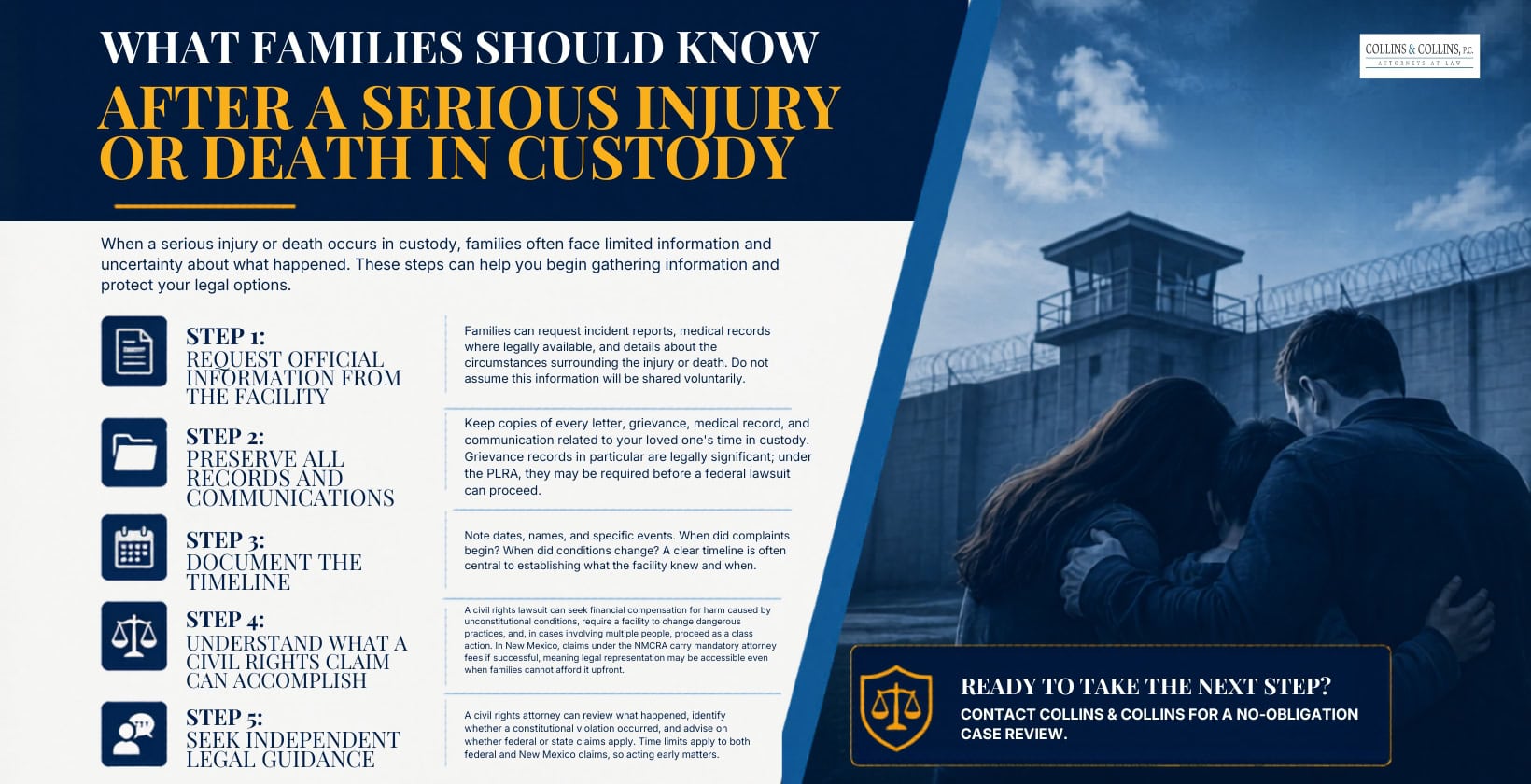
What Families Should Know After a Serious Injury or Death in Custody
When a serious injury or death occurs in custody, families often face limited information and uncertainty about what happened. These steps can help you begin gathering information and protect your legal options.
Step 1: Request official information from the facility
Families can request incident reports, medical records where legally available, and details about the circumstances surrounding the injury or death. Do not assume this information will be shared voluntarily.
Step 2: Preserve all records and communications
Keep copies of every letter, grievance, medical record, and communication related to your loved one’s time in custody. Grievance records in particular are legally significant; under the PLRA, they may be required before a federal lawsuit can proceed.
Step 3: Document the timeline
Note dates, names, and specific events. When did complaints begin? When did conditions change? A clear timeline is often central to establishing what the facility knew and when.
Step 4: Understand what a civil rights claim can accomplish
A civil rights lawsuit can seek financial compensation for harm caused by unconstitutional conditions, require a facility to change dangerous practices, and, in cases involving multiple people, proceed as a class action. In New Mexico, claims under the NMCRA carry mandatory attorney fees if successful, meaning legal representation may be accessible even when families cannot afford it upfront.
Step 5: Seek independent legal guidance
A civil rights attorney can review what happened, identify whether a constitutional violation occurred, and advise on whether federal or state claims apply. Time limits apply to both federal and New Mexico claims, so acting early matters.
Ready to take the next step? Contact Collins & Collins for a no-obligation case review.
Frequently Asked Questions About Legal Rights in Prison
Can Families File a Civil Rights Lawsuit on Behalf of Someone in Custody?
Yes. Families can pursue civil rights claims when a loved one has been seriously harmed or killed in custody. Claims can be filed under Section 1983 in federal court or under the New Mexico Civil Rights Act in state court. Which path applies depends on the specific circumstances, and a civil rights attorney can advise on the strongest available options.
What Is the Difference Between Prisoners and Detainees?
A prisoner has been convicted and is serving a sentence. A pretrial detainee is held before trial and has not been convicted. The legal distinction matters because pretrial detainees cannot be punished before conviction, and their protections under the Fourteenth Amendment are broader in some respects than those available to convicted prisoners.
Can Private Prisons or Contractors Be Held Responsible for Civil Rights Violations?
Yes. Private facilities operating under government contracts can be held responsible for constitutional violations. The legal pathways differ slightly from public facilities, but civil rights claims remain available when unconstitutional conditions cause harm.
What is the Statute of Limitations for a Prisoner’s Rights Claim in New Mexico?
Under the New Mexico Civil Rights Act, claims must be filed within three years from the date the violation occurred. Federal claims under Section 1983 follow New Mexico’s general personal injury statute of limitations, which is also three years. Missing these deadlines can permanently bar a claim, so contacting an attorney early is essential.
Does the Prison Litigation Reform Act Affect My Ability to File a Lawsuit?
Yes. The PLRA requires incarcerated individuals to exhaust all internal grievance processes before filing a federal lawsuit. If grievances were not filed or completed inside the facility, a court can dismiss the case regardless of how serious the violation was. This is why preserving grievance records from the start is critical.
When Prisoners’ Rights Are Violated, Accountability Is Possible
When correctional facilities ignore constitutional standards through medical neglect, physical abuse, or dangerous conditions, the harm that follows is not inevitable. It is the result of institutional failures that civil rights law exists to address.
Federal civil rights law and the New Mexico Civil Rights Act both provide legal pathways to hold correctional institutions responsible. But those pathways have deadlines, procedural requirements, and legal standards that are difficult to navigate without guidance.
If someone you love was seriously harmed or died in custody, you do not have to figure this out alone.
The attorneys at Collins & Collins have represented families facing exactly these circumstances. We understand what these cases require and what is at stake for the people who bring them.
Call us at 505-242-5958 for a no-obligation case review. We will listen to what happened, explain your legal options honestly, and help you understand whether a civil rights claim is the right path forward.