
407 7th St NW Albuquerque, NM 87102
info@collinsattorneys.com
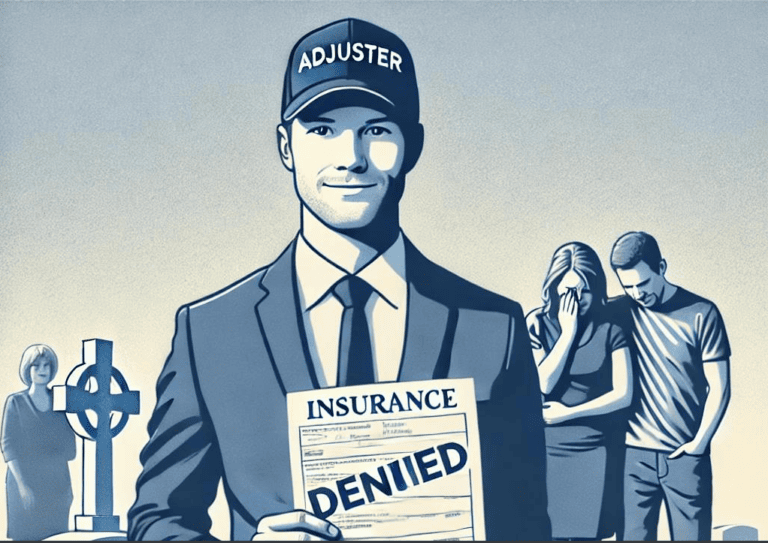
When you purchase life insurance, you trust that the policy will provide financial protection for your loved ones in the event of your death. However, life insurance companies sometimes engage in bad faith practices, denying rightful claims or delaying payment at a time when families need financial support the most.
At Collins & Collins, P.C., we are committed to holding life insurance companies accountable when they refuse to honor their promises. Bad faith denials of life insurance claims can create unnecessary hardship for grieving families, compounding the emotional toll of losing a loved one. Our firm fights to ensure that insurers meet their obligations and pay beneficiaries the benefits they are entitled to under the policy.
Life insurance bad faith occurs when an insurance company unfairly denies, delays, or underpays a legitimate life insurance claim. When this happens, families who rely on life insurance payouts are left to struggle financially, often without the resources they expected. Common examples of life insurance bad faith include:
The financial stability that life insurance is supposed to provide is often crucial for families who have lost a loved one. Life insurance is intended to cover funeral expenses, pay off debts, provide ongoing income for dependents, and help beneficiaries maintain their standard of living. When an insurer refuses to pay or delays a claim, it can leave families in financial distress, often at the worst possible time.
Life insurance companies may use a variety of bad faith tactics to avoid paying benefits. Some of the most common include:
When an insurance company engages in bad faith regarding life insurance claims, the damage can be devastating. Families rely on life insurance benefits not just for immediate expenses but for long-term financial security. Denying or delaying these benefits can have serious, long-lasting effects, such as:
At Collins & Collins, P.C., we understand the profound impact these bad faith practices have on families, and we are dedicated to ensuring that life insurance companies cannot escape their obligations.
Our firm has extensive experience taking on life insurance companies that act in bad faith. When you work with Collins & Collins, P.C., you can expect us to:
At Collins & Collins, P.C., we are in the business of holding institutions accountable—and life insurance companies are no exception. We know how devastating a denied life insurance claim can be for families, and we are passionate about making sure that these powerful companies cannot exploit their policyholders in times of grief. When life insurance companies act in bad faith, they violate not only their contractual obligations but also the trust that families placed in them during one of the most difficult times in their lives.
Our team is experienced in navigating complex life insurance disputes and has successfully taken on insurers that refuse to pay out rightful claims. We are especially motivated when large corporations attempt to escape responsibility at the expense of vulnerable families.
If you are facing a wrongful denial or delay of a life insurance claim, Collins & Collins, P.C. is here to help. We will review your case, explain your legal options, and take the necessary steps to ensure that your family receives the benefits owed to you.
Contact us today for a no-obligation consultation. We will fight to ensure that the insurance company pays what is rightfully yours, so you can focus on rebuilding your life after the loss of a loved one.
Available 24/7 Online
Copyright © 2026 – Collins & Collins P.C. All Rights Reserved.
Past results do not guarantee any future outcome, and every case is different.
Collins & Collins, P.C.
Accessibility Statement
Compliance status
We firmly believe that the internet should be available and accessible to anyone, and are committed to providing a website that is accessible to the widest possible audience, regardless of circumstance and ability.
To fulfill this, we aim to adhere as strictly as possible to the World Wide Web Consortium’s (W3C) Web Content Accessibility Guidelines 2.1 (WCAG 2.1) at the AA level. These guidelines explain how to make web content accessible to people with a wide array of disabilities. Complying with those guidelines helps us ensure that the website is accessible to all people: blind people, people with motor impairments, visual impairment, cognitive disabilities, and more.
This website utilizes various technologies that are meant to make it as accessible as possible at all times. We utilize an accessibility interface that allows persons with specific disabilities to adjust the website’s UI (user interface) and design it to their personal needs.
Additionally, the website utilizes an AI-based application that runs in the background and optimizes its accessibility level constantly. This application remediates the website’s HTML, adapts Its functionality and behavior for screen-readers used by the blind users, and for keyboard functions used by individuals with motor impairments.
If you’ve found a malfunction or have ideas for improvement, we’ll be happy to hear from you. You can reach out to the website’s operators by using the following email
Screen-reader and keyboard navigation
Our website implements the ARIA attributes (Accessible Rich Internet Applications) technique, alongside various different behavioral changes, to ensure blind users visiting with screen-readers are able to read, comprehend, and enjoy the website’s functions. As soon as a user with a screen-reader enters your site, they immediately receive a prompt to enter the Screen-Reader Profile so they can browse and operate your site effectively. Here’s how our website covers some of the most important screen-reader requirements, alongside console screenshots of code examples:
Screen-reader optimization: we run a background process that learns the website’s components from top to bottom, to ensure ongoing compliance even when updating the website. In this process, we provide screen-readers with meaningful data using the ARIA set of attributes. For example, we provide accurate form labels; descriptions for actionable icons (social media icons, search icons, cart icons, etc.); validation guidance for form inputs; element roles such as buttons, menus, modal dialogues (popups), and others. Additionally, the background process scans all the website’s images and provides an accurate and meaningful image-object-recognition-based description as an ALT (alternate text) tag for images that are not described. It will also extract texts that are embedded within the image, using an OCR (optical character recognition) technology. To turn on screen-reader adjustments at any time, users need only to press the Alt+1 keyboard combination. Screen-reader users also get automatic announcements to turn the Screen-reader mode on as soon as they enter the website.
These adjustments are compatible with all popular screen readers, including JAWS and NVDA.
Keyboard navigation optimization: The background process also adjusts the website’s HTML, and adds various behaviors using JavaScript code to make the website operable by the keyboard. This includes the ability to navigate the website using the Tab and Shift+Tab keys, operate dropdowns with the arrow keys, close them with Esc, trigger buttons and links using the Enter key, navigate between radio and checkbox elements using the arrow keys, and fill them in with the Spacebar or Enter key.Additionally, keyboard users will find quick-navigation and content-skip menus, available at any time by clicking Alt+1, or as the first elements of the site while navigating with the keyboard. The background process also handles triggered popups by moving the keyboard focus towards them as soon as they appear, and not allow the focus drift outside it.
Users can also use shortcuts such as “M” (menus), “H” (headings), “F” (forms), “B” (buttons), and “G” (graphics) to jump to specific elements.
Disability profiles supported in our website
Additional UI, design, and readability adjustments
Browser and assistive technology compatibility
We aim to support the widest array of browsers and assistive technologies as possible, so our users can choose the best fitting tools for them, with as few limitations as possible. Therefore, we have worked very hard to be able to support all major systems that comprise over 95% of the user market share including Google Chrome, Mozilla Firefox, Apple Safari, Opera and Microsoft Edge, JAWS and NVDA (screen readers).
Notes, comments, and feedback
Despite our very best efforts to allow anybody to adjust the website to their needs. There may still be pages or sections that are not fully accessible, are in the process of becoming accessible, or are lacking an adequate technological solution to make them accessible. Still, we are continually improving our accessibility, adding, updating and improving its options and features, and developing and adopting new technologies. All this is meant to reach the optimal level of accessibility, following technological advancements. For any assistance, please reach out to